Skip to content
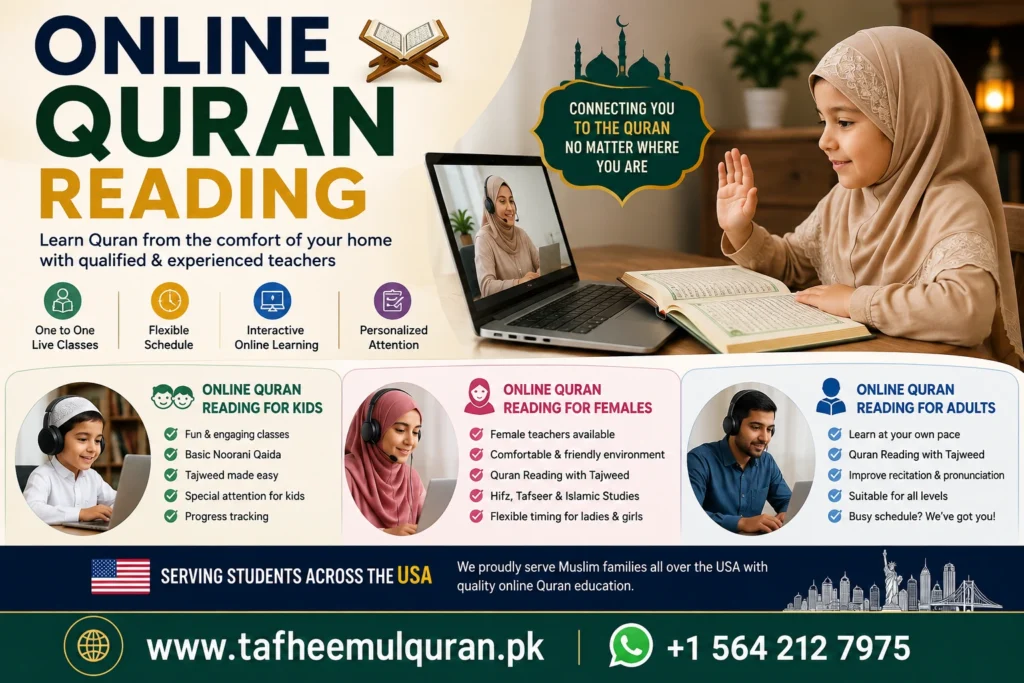
Online Quran reading gives children and adults a practical way to learn Quranic Arabic reading with a live teacher from home. A good program normally starts with Arabic letters and Noorani Qaida for beginners, then develops pronunciation, word recognition, fluency and Tajweed through repeated reading and correction.
If you are searching for Online Quran reading, don’t start by asking which academy has the biggest claims.
Start with a simpler question:
Can the teacher actually hear the student’s mistakes, explain them clearly, correct them, and build a sensible learning path from the student’s current level?
That matters more than a fancy website.
For a complete beginner, Quran reading usually begins with the Arabic alphabet and basic reading rules. A student then progresses through joining letters and reading words before moving into Quranic verses and more accurate recitation. Online Quran reading for Kids programs commonly combine this foundation with Noorani Qaida and, as the student’s reading develops, Tajweed instruction.
For families in the USA, online lessons also remove the need to travel to a physical class. A student can learn from home while the teacher works with the student through a live video session.
What does online Quran reading actually mean?
“Online Quran reading” sounds simple, but it covers several different skills.
Someone who knows the Arabic alphabet but struggles to read connected words needs a different lesson from someone who can already read the Quran but repeatedly makes pronunciation mistakes.
A useful Quran reading program should therefore begin by identifying the student’s current level.
A complete beginner may need to learn:
- Arabic letter recognition
- Correct letter sounds
- How letters connect
- Short and long vowel sounds
- Basic Arabic reading marks
- Word formation
- Reading simple combinations
- Gradually reading Quranic words and verses
A student who already knows these basics may need something else: more reading practice, pronunciation correction, fluency work and Tajweed.
This distinction is missing from many commercial pages.
They advertise “Quran reading,” “Tajweed,” “Hifz” and “Islamic Studies” together, but a parent still has to work out where the child should actually begin.
That decision should be made from the student’s ability, not from the academy’s course menu.
How does an online Quran reading class work?
The basic setup is straightforward.
The student joins a live lesson from a computer, tablet or another suitable device. The teacher displays the learning material or Quran and asks the student to read. The teacher listens, identifies mistakes and asks the student to repeat the difficult word, letter or passage.
That live correction is the part that makes a teacher-led class different from simply watching Quran videos.
A recorded lesson can explain a pronunciation rule. It cannot listen to your particular mistake and respond to it.
In a one-to-one lesson, the teacher can also adjust the pace. If the student is struggling with a particular group of letters, the teacher can spend more time there rather than moving forward simply because the syllabus says the next lesson has arrived.
Several current online Quran providers use this one-to-one model and describe it as a way to give the student individual attention.
The exact platform is less important than the teaching itself. Different academies use platforms such as Zoom, Google Meet, Microsoft Teams or their own online classroom systems.
The real test is what happens inside the lesson.
What should a beginner learn first?
If you cannot read Arabic at all, jumping directly into full Quran pages is usually a poor starting point.
A better path is progressive.
Step 1: Learn the Arabic letters
The student first needs to recognize the letters and produce their sounds.
This sounds basic. It isn’t.
If a student cannot reliably distinguish letters or pronounce them correctly, later Quran reading becomes harder because the student is building reading habits on an unstable foundation.
Step 2: Learn how letters connect
Arabic letters change their visual form depending on their position and connection with other letters.
The learner needs practice recognizing these forms rather than memorizing isolated alphabet cards forever.
Step 3: Learn the basic reading signs
The student begins applying the marks that indicate how words should be read.
The teacher should not simply ask the student to memorize rules. The student needs repeated reading practice.
Step 4: Read words and short passages
Now the student begins combining the earlier skills.
This is where the difference between “I know the Arabic alphabet” and “I can read Quranic Arabic” becomes obvious.
Knowing letters is not the same as reading.
Step 5: Begin Quran reading
Once the foundation is strong enough, the student begins reading from the Quran while the teacher listens and corrects errors.
The goal isn’t simply to reach the last page.
The goal is to develop accurate, increasingly independent recitation.
Step 6: Add Tajweed at the appropriate stage
Tajweed concerns the correct way of reciting the Quran, including pronunciation and established recitation rules.
The timing of formal Tajweed instruction should match the student’s level. A complete beginner shouldn’t be overwhelmed with a large collection of terminology before they can comfortably decode the text.
A good teacher introduces the right amount at the right time.
Is Noorani Qaida necessary for online Quran reading?
For many beginners, Noorani Qaida is a useful starting resource because it provides structured practice with Arabic letters, combinations and reading rules before the student works extensively from the Quran.
Many online Quran academies use Qaida as the foundation of their beginner programs.
But don’t turn the book into the goal.
The goal is Quran reading.
Qaida is a tool used to build the skills needed for that goal.
If a student is already capable of reading Arabic Quran text, forcing them through an entire beginner program may waste time. A teacher should assess the learner first.
That is one of the first questions I would ask before enrolling:
“Will you assess my current reading level before deciding where I start?”
If the answer is no, keep looking.
Online Quran reading for kids: what should parents look for?
Children need a different approach from adults.
A child may understand a lesson perfectly for five minutes and then lose concentration. That isn’t necessarily a sign that the child cannot learn Quran. It may simply mean the lesson needs to be structured around the child’s age and attention level.
Current children’s programs commonly emphasize short focused activities, repetition, encouragement and individualized pacing.
For online Quran reading for kids, look for five things.
1. The teacher knows how to teach children
Knowing Quran is one skill.
Teaching a child is another.
A teacher can have strong Quran knowledge and still be a poor teacher for a young child.
During a trial lesson, watch what happens when the child makes a mistake.
Does the teacher immediately become frustrated?
Does the teacher simply give the answer?
Or does the teacher explain the mistake, let the child try again and encourage the child to correct it?
That tells you much more than a certificate displayed on a website.
2. The lesson matches the child’s level
A five-year-old beginner should not be treated like an adult beginner.
Children’s online Quran programs may begin with Arabic letters and Qaida and gradually move toward Quran reading and Tajweed.
The important word is gradually.
3. Parents can see whether progress is happening
Ask how progress is measured.
You don’t necessarily need a complicated dashboard.
A simple explanation is enough:
“What should my child be able to read after the next stage?”
“Which letters or rules are we working on now?”
“What mistakes does my child repeatedly make?”
“Has my child’s reading improved compared with the first assessment?”
If the academy cannot answer these questions, its “progress tracking” claim isn’t very useful.
4. The teacher corrects pronunciation
A child who reads quickly while making the same pronunciation errors isn’t necessarily progressing well.
The teacher should listen carefully.
Speed comes later.
5. The class fits the child’s routine
A class schedule that looks perfect on paper but constantly conflicts with school, homework, meals or sleep will eventually fail.
Choose a schedule the family can maintain.
Consistency beats an ambitious schedule that lasts two weeks.
Online Quran reading for adults is not “too late”
Adults sometimes delay learning because they think everyone else started as a child.
That is the wrong comparison.
An adult beginner needs a teacher who is willing to start at the actual level rather than assuming prior knowledge.
Some adults know the alphabet but read slowly. Others can recognize Arabic words but struggle with pronunciation. Some can read the Quran but want to improve Tajweed.
These are three different starting points.
A good online Quran reading course should accommodate those differences.
Several current providers explicitly offer Quran reading programs for both adults and children.
For adults, private lessons can also remove one common obstacle: embarrassment.
There is no reason an adult beginner should have to read in front of a large group while worrying about making mistakes.
A private teacher can correct the learner without turning every mistake into a public event.
What about online Quran reading for females?
Female students may prefer a female Quran tutor for personal, cultural or family reasons.
That option is widely offered by online Quran academies, although the exact teacher qualifications and policies vary by provider. Current USA-focused services advertise both male and female Quran tutors.
If a female tutor matters to you, don’t stop at the statement “female teachers available.”
Ask:
- Can I request a female teacher?
- Is the teacher assigned based on availability or preference?
- Can I meet the teacher during the trial?
- What happens if the teacher isn’t a good fit?
- Does the same teacher normally continue with the student?
These questions expose the difference between a genuine service option and a marketing checkbox.
How should parents choose an online Quran tutor?
This is where you should ignore most marketing language.
“Experienced.”
“Qualified.”
“Best.”
“Professional.”
“Trusted.”
Every academy can write these words.
Instead, test the teacher.
Watch the first lesson
Don’t treat the free trial as a sales presentation.
Treat it as an assessment.
Give the teacher enough opportunity to see the student’s real ability.
Then ask yourself:
Did the teacher listen?
Did the teacher identify specific mistakes?
Did the teacher explain what comes next?
Did the child feel comfortable enough to participate?
Did the teacher adapt when the student struggled?
Those observations are more useful than a five-star graphic.
Ask what happens after the trial
A serious academy should be able to explain the proposed learning path.
For example:
“Your child knows the letters but needs work on joining and vowel marks, so we recommend beginning at this stage.”
That is a useful answer.
“Your child is perfect for our premium Quran package” isn’t.
Should you choose one-to-one or group Quran classes?
For Quran reading, I would choose one-to-one instruction for beginners who need frequent correction, particularly children who are starting from zero or students with significant pronunciation problems.
The reason is simple.
Reading practice requires the teacher to hear the student.
In a group, the teacher’s attention is divided. In a private lesson, the teacher can listen to every passage the student reads and adjust the lesson immediately.
That doesn’t mean group classes are automatically bad.
A group can work for students who already have a foundation, prefer learning with others, or are working on a topic where individual correction is less intensive.
But if the goal is basic reading accuracy, private instruction has a clear practical advantage: more direct teacher-student interaction.
Online Quran reading versus learning from an app
An app can be useful.
It can help with repetition, vocabulary, listening practice and independent review.
But an app isn’t a substitute for a teacher when the learner doesn’t know whether they are making a pronunciation mistake.
Think of the two tools differently.
App: practice.
Teacher: instruction and correction.
If you already read Quran confidently, self-study tools may be enough for certain areas of improvement.
If you cannot read Arabic Quran text, relying entirely on an app puts the responsibility for identifying mistakes on the learner — exactly the person who may not know what the mistake is.
What should a good online Quran reading curriculum include?
A useful curriculum should show a progression instead of presenting a random collection of Quran courses.
For a beginner, a sensible structure could look like this:
Foundation: Arabic letters, sounds and recognition.
Reading mechanics: connecting letters and applying basic reading marks.
Qaida practice: progressively more difficult combinations and words.
Quran reading: reading actual Quranic text with teacher correction.
Pronunciation: identifying recurring articulation problems.
Tajweed: learning and applying appropriate recitation rules.
Fluency: improving accuracy and confidence through repeated reading.
The exact order can differ according to the learner.
An adult who already reads Quran should not necessarily restart from the alphabet.
A child who cannot recognize Arabic letters should not be placed directly into an advanced Tajweed class.
The curriculum should follow the student.
How many classes per week should you take?
There is no honest universal number.
The right schedule depends on the student’s starting level, age, available time and ability to practice between lessons.
What matters is that the schedule is sustainable.
A parent who chooses a demanding timetable and cannot maintain it hasn’t created a better Quran-learning plan.
They have created a plan that will probably collapse.
Ask the academy whether it can recommend a schedule after assessing the student.
Then make sure there is enough time between lessons for review.
A student who attends a lesson and never opens the material again is making the teacher fight against their own lack of practice.
How long does it take to learn Quran reading?
Be suspicious of anyone who promises a precise completion time before assessing the student.
A beginner’s timeline depends on factors such as:
- Previous Arabic knowledge
- Age and learning ability
- Frequency of lessons
- Practice between classes
- Reading difficulties
- Pronunciation challenges
- Consistency
- Quality of teacher correction
One current provider, for example, says the time needed to complete Noorani Qaida varies according to factors such as age, prior familiarity and class frequency.
That is a better approach than giving every student the same deadline.
The meaningful measurement isn’t simply “How many months until I finish?”
Ask instead:
“What can I read accurately now that I could not read before?”
That’s progress.
What should a USA parent ask an online Quran academy before enrolling?
If you live in the USA, don’t choose an academy solely because the page says “USA.”
Ask practical questions.
Do you teach students in my time zone?
Can my child have a consistent teacher?
Do you offer male and female tutors?
How do you assess a beginner?
What curriculum do you use for Quran reading?
How do you track progress?
Can parents observe classes?
What happens if the teacher isn’t a good fit?
How are missed classes handled?
Which platform do you use?
Is there a trial lesson?
What exactly happens during the trial?
These questions force the provider to explain the service instead of repeating marketing copy.
What are the biggest mistakes people make when choosing online Quran classes?
Choosing the cheapest teacher without testing the teaching
Price matters.
But Quran reading is a skill that depends heavily on correction. Saving money on a poor teacher can simply mean spending more time fixing the same mistakes later.
Choosing based on “certified” alone
Certification can be relevant, but it doesn’t automatically prove that the person is a good teacher for your particular child.
Teaching ability still has to be observed.
Starting at the wrong level
This happens in both directions.
Some beginners are pushed forward too quickly.
Others who already know how to read are forced through basic material they don’t need.
Assessment should come first.
Focusing on speed instead of accuracy
Finishing pages quickly isn’t the same as reading them correctly.
A student who reads slowly but improves accuracy is moving in the right direction.
Buying a large course package immediately
Don’t commit to a long-term package before you know whether the teacher and learning method suit the student.
Use a trial where available.
Test the actual class.
Then decide.
Treating the teacher as a babysitter
This is particularly dangerous with children.
An online Quran teacher is there to teach Quran.
Parents still need to create the environment for learning: working device, reasonable quiet, punctual attendance and enough attention for the child to participate.
How can a child practice between online Quran classes?
Keep practice manageable.
The child should review what was actually taught rather than randomly opening a Quran page and trying to read difficult material.
Parents can ask the teacher:
“What should we practice before the next class?”
Then follow that instruction.
If the child is learning particular letters, words or passages, practice those.
If the child is working on a recitation rule, reinforce that rule during the assigned reading.
The purpose of home practice isn’t to replace the teacher.
It is to make the teacher’s correction stick.
What makes an online Quran academy worth choosing?
Forget the academy that simply has the longest list of courses.
A stronger academy should make five things clear:
Who teaches?
You should know whether male and female teachers are available and what information the academy provides about their qualifications.
How do they teach?
You should understand whether lessons are private, group-based, live, recorded or a combination.
Where does the student start?
There should be some form of level assessment.
How is progress judged?
You should be able to understand what the student is expected to improve.
What happens if the teacher isn’t suitable?
There should be a clear process for handling a poor teacher-student fit.
These questions are more valuable than claims about being the “#1” academy.
Online Quran reading can work very well — if the teaching is actually live
The biggest advantage of online Quran education isn’t that the student can sit in front of a screen.
It’s that the teacher can work with the student wherever they live.
A child in the USA doesn’t need to travel to a local Online Quran School simply because the family cannot find the right teacher nearby. An adult who never learned Arabic can begin privately without feeling uncomfortable in a classroom. A female student can look specifically for a Online Female Quran tutor if that is her preference.
Current Online Quran Academy providers serving international students commonly build their services around this combination of live teaching, flexible scheduling and individual attention.
But online delivery doesn’t automatically make teaching good.
The screen is only the delivery method.
The teacher, curriculum, correction and consistency determine whether the student actually learns.
A simple way to choose your Quran reading program
Don’t spend three hours comparing logos.
Do this instead.
First, identify the learner’s level.
Can they recognize Arabic letters?
Can they join letters?
Can they read simple Arabic words?
Can they already read Quran?
Do they need Tajweed correction?
Second, decide who should teach them.
For a child, look for someone experienced with children.
For a female student who prefers a woman teacher, confirm that a female tutor is genuinely available.
For an adult beginner, find someone comfortable teaching adults from the basics.
Third, take the trial lesson seriously.
Watch how the teacher teaches, not how the sales page looks.
Fourth, ask for the learning plan.
You should know what the student will work on first and what comes next.
Finally, choose the schedule you can maintain.
A sustainable routine beats an impressive schedule that the family cannot keep.
Is online Quran reading right for you?
It probably is if you need a teacher but don’t want to travel to a physical Quran school, your schedule changes around school or work, or you want individual instruction.
It is especially practical for families who live in areas where finding a suitable local Quran teacher is difficult.
It is less suitable if you expect an online class to produce results without regular attendance, attention and practice.
No website can fix that.
The same principle applies to children and adults: the technology gets you into the classroom; the quality of teaching and your consistency determine what you learn.
For families looking for online Quran classes in the USA, the next sensible step is not to buy a package.
Book a trial, let the teacher assess the student’s reading level, ask what the first learning stage should be, and watch how the teacher handles mistakes.
If the explanation is clear and the teaching fits the learner, continue.
If it isn’t, move on.
That’s a much better way to choose an online Quran reading program than trusting a “best academy” badge on a website.
Frequently Asked Questions About Online Quran Reading
1. What is online Quran reading?
Online Quran reading is live Quran instruction provided through the internet. A student reads Quranic Arabic with a teacher who listens, corrects mistakes, teaches pronunciation and gradually improves reading accuracy and fluency.
2. Can I learn Quran reading online from home?
Yes. Students can learn Quran reading from home through live online lessons with a qualified tutor. This option is useful for children, adults and families who prefer learning without traveling to a physical Quran school.
3. Is online Quran reading suitable for beginners?
Yes. Beginners can start from the Arabic alphabet and Noorani Qaida before progressing to Quranic words, verses and more advanced reading. A good teacher should assess the student’s existing ability before selecting the starting level.
4. How do I learn Quran reading online?
Start by choosing a live Quran teacher or academy, complete an assessment or trial lesson, begin at the appropriate reading level and attend lessons consistently. Regular practice between classes helps reinforce what the teacher corrects.
5. Can children learn Quran reading online?
Yes. Online Quran reading for kids is widely offered by online Quran academies. Children’s lessons should be adapted to their age, reading ability and attention level rather than using exactly the same approach as adult classes.
6. Is online Quran reading for kids in the USA available?
Yes. Families in the USA can enroll children in online Quran reading programs with teachers who provide live lessons remotely. Parents should confirm the class schedule, teacher availability and teaching method before enrolling.
7. What should children learn first when starting Quran reading?
A child who cannot read Arabic should normally begin with Arabic letters and basic reading skills, followed by connected letters, reading marks and Noorani Qaida practice. Once the foundation is strong enough, the child can progress to reading directly from the Quran.
8. What is Noorani Qaida and why is it used for Quran reading?
Noorani Qaida is a beginner learning resource used to teach foundational Arabic reading and Quran recitation skills. It gives students structured practice before they progress to reading longer passages from the Quran.
9. Can adults learn Quran reading online?
Yes. Online Quran reading for adults is suitable for complete beginners as well as adults who already recognize Arabic but want to improve their reading, pronunciation or Tajweed.
10. Can someone learn Quran reading without knowing Arabic?
Yes. Quran reading and speaking conversational Arabic are different skills. A beginner can learn to recognize Arabic letters, understand reading marks and decode Quranic text without first becoming fluent in spoken Arabic.
11. How long does it take to learn Quran reading online?
There is no honest fixed timeframe for every student. The learning period depends on the student’s starting level, consistency, lesson frequency, practice and reading difficulties. A teacher should assess the student before giving a realistic learning plan.
12. Can I learn Quran reading with Tajweed online?
Yes. Many online Quran programs combine Quran reading with Tajweed instruction. For beginners, the teacher should introduce Tajweed according to the student’s reading ability instead of overwhelming the learner with advanced rules immediately.
13. What is the difference between Quran reading and Tajweed?
Quran reading focuses on learning to decode and read the Arabic Quranic text. Tajweed focuses on applying the established rules of Quranic recitation, including correct pronunciation and appropriate articulation during recitation.
14. Are online Quran classes one-to-one?
Many online Quran academies offer one-to-one lessons, although some also provide group classes. One-to-one teaching gives the tutor more opportunity to listen to an individual student’s recitation and correct mistakes during the lesson.
15. Are online Quran classes for kids better than group classes?
For a beginner who needs frequent individual correction, one-to-one instruction is usually the stronger choice. Group classes can suit students who already have a foundation or prefer learning with other students, but the right choice depends on the learner.
16. Can I get a female Quran tutor online?
Yes. Many online Quran academies offer female Quran tutors. If a female teacher is important to you, confirm that the academy can provide one before enrolling rather than relying only on a general “female teachers available” statement.
17. Are there online Quran classes for females?
Yes. Women and girls can take live online Quran classes with female tutors where the academy offers that option. Courses may include Quran reading, Noorani Qaida, Tajweed, memorization and Islamic studies depending on the provider.
18. Can I find online Quran classes for adults in the USA?
Yes. Online Quran academies serve adult learners in the USA through live remote lessons. Adults can usually begin at their existing level, whether they are complete beginners or already able to read Quranic Arabic.
19. How do I choose the best online Quran academy?
Don’t choose an academy simply because its website calls it the “best.” Check the teacher’s ability, lesson format, curriculum, level assessment, scheduling, progress tracking and trial-class experience. The best academy is the one that fits the student’s actual needs.
20. What should I look for in an online Quran tutor?
Look for a tutor who can teach at the student’s level, listen carefully to recitation, identify pronunciation mistakes, explain corrections clearly and maintain an appropriate pace. For children, teaching ability matters just as much as Quran knowledge.
21. How can parents know whether their child is improving in Quran reading?
Parents should ask the teacher what the child is currently learning, which mistakes are being corrected and what the child should be able to do next. Comparing the child’s reading ability over time is more useful than simply counting completed lessons.
22. Can I take a trial online Quran class before enrolling?
Many online Quran academies offer trial lessons, although the terms vary between providers. A trial should be used to evaluate the teacher, the student’s comfort, the quality of correction and whether the proposed learning level makes sense.
23. What happens during an online Quran reading trial class?
The teacher may assess the student’s Arabic reading ability, listen to Quran recitation, identify errors and explain where the student should begin. Parents should pay attention to how the tutor responds to mistakes rather than treating the trial as only a sales meeting.
24. Do I need a computer for online Quran classes?
Not necessarily. Depending on the academy’s platform, students may be able to attend using a computer, tablet or smartphone. A reliable internet connection, working microphone and camera are also useful for live Quran lessons.
25. What internet connection do I need for online Quran reading?
You need a connection that supports stable live audio and video. The exact internet speed requirement depends on the video platform and device, but unstable audio is a bigger practical problem than having an exceptionally fast connection.
26. Can children attend online Quran classes after school?
Yes. Online learning allows families to schedule Quran lessons around school and other responsibilities. The best schedule is one the child can consistently maintain without being excessively tired or distracted.
27. Can I learn Quran reading online if I am a complete beginner?
Yes. Complete beginners can start from the alphabet and foundational reading material. Tell the teacher clearly that you are starting from zero so the tutor can avoid assuming previous Arabic knowledge.
28. Are online Quran tutors available for students in different time zones?
Many international online Quran academies schedule lessons for students living in different countries and time zones. Before enrolling, confirm that the available teaching hours match your local schedule, particularly if you are studying from the USA.
29. Is online Quran reading better than learning Quran from an app?
For beginners, live teacher-led learning has an important advantage: the teacher can listen to the student’s recitation and correct individual mistakes. Apps can be useful for additional practice, but they do not replace the feedback of a live tutor.
30. How can I start online Quran reading classes?
Begin by choosing a reputable online Quran academy, request a trial or assessment, tell the teacher the student’s current level and discuss the preferred class schedule. After the assessment, choose a learning plan that the student can realistically maintain. Trustpilot Reviews