Skip to content
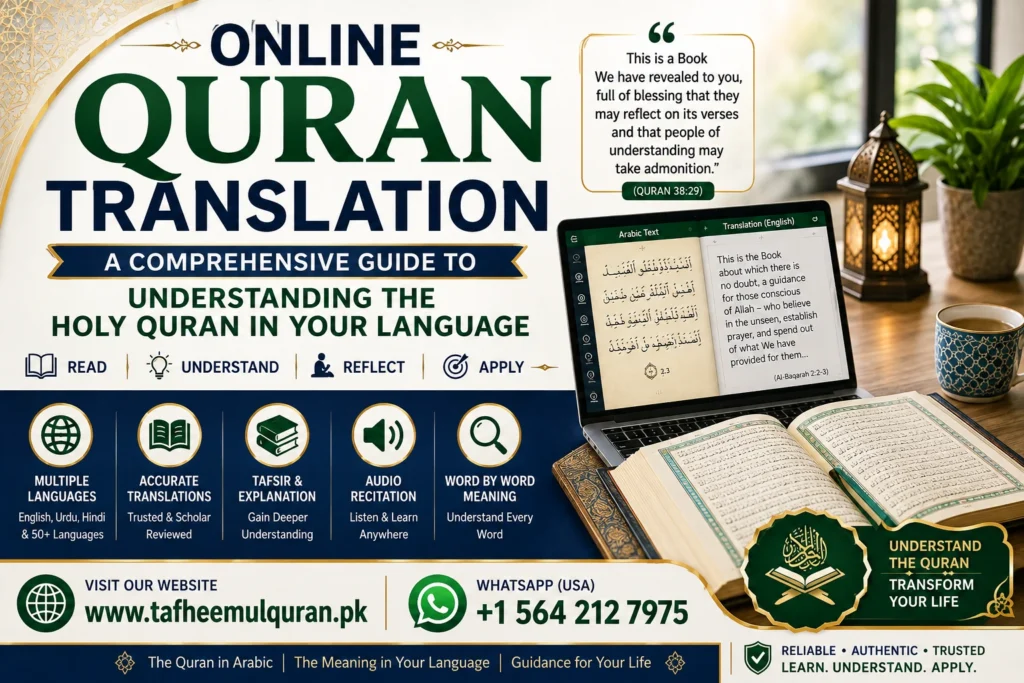
The Quran is the central religious text of Islam, revealed in Arabic to Prophet Muhammad ﷺ. While Muslims believe the original Arabic Quran is the revealed word of Allah, millions of Muslims around the world do not speak Arabic as their first language. This is why Online Quran translation has become an important way for people to understand the meanings, guidance, lessons, and messages of the Holy Quran in a language they understand.
Today, Muslims can access Quran translation online in English, Urdu, Hindi, Bengali, French, Spanish, Turkish, German, Indonesian, and many other languages. Digital Quran platforms also provide Arabic text, translations, word-by-word meanings, Tafsir, recitations, and search tools in one place.
However, reading a translation should be approached correctly. A translation communicates the Meaning of the Quran, but it cannot reproduce every linguistic, rhetorical, contextual, and interpretive feature of the original Arabic text.
This comprehensive guide explains what Quran translation is, why it matters, how to choose a reliable translation, the difference between translation and Tafsir, and how beginners can use online Quran translation effectively.
What Is Online Quran Translation?
Online Quran translation means accessing a translated explanation or rendering of the meanings of Quranic verses through a website, mobile application, digital Quran platform, or online learning service.
The original Quran is in Arabic. A translation attempts to communicate the meaning of the Arabic text in another language, such as English or Urdu.
For example, a person who cannot understand Arabic may read an English Quran translation alongside the Arabic text. This can help the reader understand the general meaning of verses while continuing to recognize the importance of the original Arabic.
The King Fahd Glorious Quran Printing Complex has a dedicated center concerned with producing, reviewing, and studying translations of the meanings of the Quran in different languages. Its official information explains that the translation work involves scholarly review and research into translation issues.
Digital platforms have also made Quran translations much easier to access. Quran.com, for example, provides multiple translations, Tafsir, recitations, word-by-word tools, and other Quran study features.
Why Is Quran Translation Important?
Understanding the Quran is not limited to reading its Arabic letters. For Muslims who do not understand Arabic, learning the meanings can make Quran reading more meaningful and reflective.
1. It Helps You Understand the Message
A person may be able to recite Arabic without understanding every word. A reliable translation can help explain the general message of a verse.
This allows readers to think about:
- Allah’s guidance
- Faith and worship
- Good character
- Family responsibilities
- Justice and compassion
- Patience and gratitude
- Repentance
- Accountability
- The Hereafter
- Lessons from previous nations and prophets
2. It Makes Quran Study Accessible
Not every Muslim has the opportunity to study Arabic immediately. Online Quran Academy USA provides an accessible starting point for people who want to understand what they are reading.
3. It Helps Children and New Muslims
Children growing up in English-speaking countries may know how to recite short surahs but struggle to understand their meanings.
Similarly, new Muslims often benefit from reading the Quran in their native language while gradually learning Arabic terminology.
4. It Supports Personal Reflection
Understanding the meaning of a verse can encourage deeper reflection and connection with the Quran.
The Quran itself repeatedly encourages people to think, reflect, and understand its message. For example, Quran 12:2 describes the revelation as an Arabic Quran so that people may understand.
Is a Quran Translation the Same as the Quran?
No.
This is one of the most important things beginners should understand.
The Quran was revealed in Arabic. A translation is a human attempt to communicate the meanings of the Arabic Quran in another language.
Different translators may choose different words or sentence structures while attempting to convey the same underlying meaning.
For this reason, readers should avoid treating a translated wording as if it were identical to the original Arabic revelation.
The King Fahd Complex itself uses the expression “Translations of the Meanings of the Qur’an,” reflecting the distinction between the Arabic revelation and translations of its meanings.
A useful approach is:
Arabic Quran → Translation of meanings → Tafsir/context → Reflection and learning
Quran Translation vs. Tafsir: What Is the Difference?
Many people confuse Quran translation with Tafsir, but they serve different purposes.
Quran Translation
A translation primarily attempts to communicate the meaning of Arabic Quranic verses in another language.
For example:
Arabic verse → English meaning
The goal is accessibility and understanding.
Tafsir
Tafsir is the explanation and interpretation of the Quran. It may discuss:
- Historical context
- Arabic vocabulary
- Grammar
- Related Quranic verses
- Hadith
- Statements of early scholars
- Reasons for revelation where established
- Legal and theological implications
- Scholarly interpretations
Quran.com, for example, provides both translations and Tafsir resources, allowing readers to move from basic meaning toward deeper study.
Which One Should Beginners Use?
A beginner can start with a reliable translation to understand the general meaning.
For difficult verses, however, it is better to consult a recognized Tafsir or qualified teacher instead of relying on an isolated translation.
Quran 16:44 emphasizes the Prophet’s role in explaining what had been revealed, which is an important reminder that Quranic understanding involves explanation as well as recitation.
What Languages Are Available for Online Quran Translation?
One of the biggest advantages of digital Quran resources is the availability of multiple languages.
Depending on the platform, readers may find:
- English Quran Translation
- Urdu Quran Translation
- Hindi Quran Translation
- Bengali Quran Translation
- French Quran Translation
- Spanish Quran Translation
- German Quran Translation
- Turkish Quran Translation
- Indonesian Quran Translation
- Malay Quran Translation
- Russian Quran Translation
- Chinese Quran Translation
- Persian Quran Translation
- Portuguese Quran Translation
- Swahili Quran Translation
- And many additional languages
The King Fahd Complex has developed Quran translations in numerous Asian, European, and African languages. Its published information lists translations and digital resources covering a wide range of languages.
A recent 2026 report also stated that the King Fahd Complex had made more than 44 digital Quran translations available online through its official website.
How to Read the Quran With Translation Online
If you are new to Quran translation , you do not need a complicated study system.
Follow these simple steps.
Step 1: Start With the Arabic Text
If possible, keep the Arabic Quran visible alongside your translation.
This helps you maintain a connection with the original text while using your preferred language for understanding.
Step 2: Read the Translation Slowly
Do not rush through pages simply to complete a target.
Read a few verses and ask:
- What is this verse teaching?
- What is the main message?
- What behavior is encouraged?
- What behavior is discouraged?
- How does this apply to my life?
Step 3: Look at the Context
A verse should not always be interpreted in isolation.
Read the verses before and after it. Consider the subject of the surah and, when appropriate, consult a reliable Tafsir.
Step 4: Compare Carefully
For serious study, reading more than one reputable translation can sometimes help identify differences in wording.
However, comparing translations should not become an excuse to select whichever wording supports a personal opinion.
Step 5: Ask a Qualified Teacher
If you encounter a difficult theological, legal, linguistic, or interpretive question, ask a qualified Quran teacher or Islamic scholar.
Best Way to Learn Quran With Translation
A strong Online Quran learning combines several skills instead of depending on translation alone.
Recommended Learning Path
1. Learn Noorani Qaida
Beginners can learn Arabic letters, pronunciation, joining rules, and basic reading skills.
2. Improve Quran Reading
Develop fluency and accuracy in reading the Arabic Quran.
3. Learn Tajweed
Study the rules of Quranic pronunciation and recitation.
4. Read Translation
Understand the meaning in your preferred language.
5. Study Tafsir
Explore the explanation and context of important passages.
6. Ask Questions
Discuss difficult verses with a qualified teacher or scholar.
7. Apply the Lessons
The ultimate goal is not simply collecting information. Quran study should encourage reflection, character development, worship, and righteous action.
Online Quran Translation for Kids
Parents often search for Online Quran translation for kids in USA because children may be able to read Arabic without understanding what they are reciting.
For children, translation should be taught in an age-appropriate manner.
A good children’s Quran program can combine:
- Arabic reading
- Noorani Qaida
- Tajweed
- Short Surahs
- Basic Quran vocabulary
- Translation of selected verses
- Islamic manners
- Stories of the Prophets
- Age-appropriate Tafsir
- Questions and answers
Children should not be overwhelmed with complicated scholarly discussions.
Instead, teachers can explain a verse in simple language and connect its lesson to everyday situations.
For example, when teaching verses about honesty, children can discuss how honesty applies at school, at home, and when interacting with friends.
Online Quran Translation for Adults
Adults may have different goals.
Some want to understand the Quran during daily recitation. Others want to study particular surahs, improve their Islamic knowledge, or understand the meanings of verses used in prayer.
A structured Online Quran translation course for adults can include:
- Arabic reading assessment
- Quran recitation
- Translation
- Vocabulary
- Selected Tafsir
- Surah-by-surah study
- Quranic themes
- Questions and discussion
- Practical lessons
Adults who already read Quran fluently may choose to spend more time on translation and Tafsir rather than beginner reading lessons.
Online Quran Translation for New Muslims
New Muslims can particularly benefit from learning the Quran in a language they already understand.
However, a new Muslim does not need to learn everything at once.
A practical starting plan is:
Beginner Stage
Learn:
- Basic Arabic letters
- Quran pronunciation
- Short Surahs
- Essential Islamic vocabulary
- Translation of selected passages
Intermediate Stage
Progress to:
- Tajweed
- Longer Surahs
- Quranic vocabulary
- Basic Tafsir
- Seerah connections
- Hadith related to Quranic teachings
Advanced Stage
Students may explore:
- Arabic language
- Classical Tafsir
- Quranic sciences
- Linguistic analysis
- Comparative Tafsir
- Specialized Islamic studies
The learning process should be gradual and guided.
How to Choose a Reliable Quran Translation
Not every translation website should automatically be considered equally reliable.
Before using an online translation for serious study, consider the following factors.
1. Check the Translator
Look for information about the translator’s education, methodology, language expertise, and scholarly background.
2. Check the Source
Prefer established Quran institutions, recognized publishers, reputable academic projects, or well-documented Islamic resources.
3. Look for Scholarly Review
A translation that has undergone careful review can provide additional confidence.
For example, the King Fahd Complex describes scholarly work involving translation, review, research, and addressing translation-related issues.
4. Avoid Anonymous Translations
If a website does not explain where its translation came from, be cautious.
5. Do Not Depend on Machine Translation
Artificial intelligence and automatic translation can be useful technologies, but Quranic Arabic is highly nuanced.
A machine-generated translation should not replace a carefully prepared scholarly translation.
6. Check Whether Tafsir Is Available
A platform offering translation alongside Tafsir can be particularly useful when studying difficult verses.
Why Machine Translation of the Quran Can Be Problematic
Modern technology makes it easy to translate almost anything instantly.
However, Quranic Arabic presents unique challenges.
A single Arabic word may carry several related meanings depending on:
- Context
- Grammar
- Syntax
- Word form
- Classical Arabic usage
- Surrounding verses
- Scholarly interpretation
A computer system may produce grammatically acceptable language while still missing an important nuance.
Therefore, AI Quran translation should not be treated as a substitute for established scholarly translations.
Technology can assist Quran study, but the responsibility for religious interpretation requires appropriate scholarship and verification.
Should You Read More Than One Quran Translation?
Yes, in many cases comparing reputable translations can be helpful.
Different translators may use different English words to communicate an Arabic expression.
For example, one translation might use a more literal expression while another uses smoother contemporary English.
Comparing them can help readers recognize that:
Arabic meaning → translated wording
is not always a one-to-one process.
However, translation comparison should be used for understanding rather than cherry-picking whichever wording confirms a preconceived idea.
For advanced questions, consult Tafsir and qualified scholarship.
Quran Translation and Word-by-Word Meaning
Another useful Quran study method is word-by-word Quran translation.
Instead of reading only a complete English sentence, learners can examine individual Arabic words and their approximate meanings.
This can help students gradually develop Quranic vocabulary.
Digital Quran platforms increasingly combine:
- Arabic text
- Word-by-word meanings
- Full translations
- Transliteration
- Audio recitation
- Tafsir
- Search
- Notes and bookmarks
Quran.com, for example, provides word-by-word translation and multiple translation options as part of its Quran study tools.
Benefits of Studying Quran Translation Every Day
You do not need to study dozens of pages every day.
Consistency is more important than speed.
Even a short daily session can help develop a habit of Quran reflection.
A 20-Minute Daily Quran Routine
5 minutes: Read Arabic Quran
5 minutes: Read the translation
5 minutes: Review vocabulary or Tafsir
5 minutes: Reflect on one practical lesson
The goal is to build a sustainable habit.
Common Mistakes to Avoid When Using Quran Translation Online
Mistake 1: Treating Translation as the Original Quran
A translation communicates meanings but is not identical to the Arabic revelation.
Mistake 2: Reading Verses Without Context
Avoid drawing major conclusions from a single translated sentence without considering the surrounding passage and relevant scholarship.
Mistake 3: Using Random Websites
Check the source and credentials behind a translation.
Mistake 4: Relying Entirely on AI
AI can assist with language and research, but it should not replace qualified Islamic scholarship.
Mistake 5: Ignoring Arabic
Even if you begin with translation, gradually learning Arabic Quran reading and pronunciation is highly beneficial.
Mistake 6: Confusing Translation With Tafsir
A translation and an explanation of the Quran are not the same thing.
Mistake 7: Looking for Only One Translation
Comparing reputable translations can sometimes clarify differences in wording and interpretation.
How Parents Can Teach Quran Translation to Children
Parents can make Quran translation more engaging by connecting lessons to real life.
For example:
Quranic Lesson: Honesty
Ask:
“What should you do if you accidentally break something at home?”
Then connect the child’s answer to the Quranic emphasis on truthful and responsible behavior.
Quranic Lesson: Patience
Ask:
“What can you do when something does not happen the way you want?”
Then discuss patience and trust in Allah.
Quranic Lesson: Gratitude
Ask children to identify three blessings they experienced that day.
This makes Quran learning practical rather than purely memorization-based.
How Online Quran Classes Can Teach Translation
A professional online Quran class can combine live instruction with translation and explanation.
A typical lesson might follow this structure:
First 5 Minutes
Review the previous lesson.
Next 10 Minutes
Quran recitation and Tajweed correction.
Next 10 Minutes
Read the translation of selected verses.
Next 10 Minutes
Teacher explains important vocabulary and lessons.
Final 5 Minutes
Questions, revision, and homework.
This approach allows students to develop both Quran reading skills and Quran understanding.
For children especially, lessons should remain interactive and appropriate for their age.
A Good Online Quran Translation Study Plan
Here is a simple four-week plan for beginners.
Week 1: Learn the Basics
Study:
- What Quran translation means
- Difference between Quran and translation
- Difference between translation and Tafsir
- How to choose a reliable translation
Week 2: Start Daily Reading
Read:
- Arabic text
- Translation
- Short explanation
Focus on consistency.
Week 3: Build Vocabulary
Select 5–10 frequently occurring Quranic words.
Learn their meanings and observe how they appear in different verses.
Week 4: Add Tafsir
Choose selected passages and read a reliable Tafsir alongside the translation.
Record important lessons and questions for discussion with a qualified teacher.
Frequently Asked Questions About Online Quran Translation
What is the best way to read the Quran with translation?
Read the Arabic text alongside a reputable translation. For difficult passages, consult Tafsir or a qualified Quran teacher.
Is Quran translation the same as the Quran?
No. The Quran was revealed in Arabic. A translation communicates the meanings of the Arabic text in another language.
Can I read Quran translation online for free?
Yes. Several established digital Quran platforms provide free access to Quran translations and study tools. Quran.com, for example, provides translations, Tafsir, recitation, and word-by-word resources.
Which language should I choose for Quran translation?
Choose a language you understand well. English, Urdu, Hindi, Bengali, French, Spanish, Turkish, and many other languages are available through different Quran resources.
Is English Quran translation reliable?
There are several reputable English translations, but readers should check the translator, source, methodology, and scholarly background rather than assuming every online translation has the same reliability.
Should children learn Quran translation?
Yes. Age-appropriate translation and explanation can help children understand what they recite and connect Quranic teachings with everyday life.
Should I learn Arabic if I read Quran translation?
Learning Arabic is beneficial because it allows Muslims to engage directly with the original language of the Quran. However, translation can remain an important tool for understanding while Arabic skills develop.
What is the difference between Quran translation and Tafsir?
Translation communicates the meaning of the Arabic text in another language. Tafsir provides a deeper explanation involving context, language, related evidence, and scholarly interpretation.
Can Google or AI translate the Quran accurately?
Automatic translation can assist with language research, but it should not replace established scholarly Quran translations or qualified Islamic scholarship.
Final Thoughts: Understanding the Quran in Your Own Language
Online Quran translation has made Quranic understanding more accessible to Muslims around the world.
For someone who does not understand Arabic, reading a reputable translation can open the door to understanding the Quran’s guidance, stories, principles, warnings, promises, and lessons.
The best approach is not to choose between Arabic and translation. Instead, use both:
Read the Arabic → Understand the translation → Study the Tafsir → Reflect → Apply the lesson
Digital resources have made this process easier than ever. Established Quran platforms provide Arabic text, translations, recitations, word-by-word meanings, and Tafsir, while institutions such as the King Fahd Glorious Quran Printing Complex continue to support translation and scholarly work in many languages.
For Muslims living in the USA, UK, Canada, Australia, or other non-Arabic-speaking communities, learn Quran with translation online can be an effective way to combine Quran reading with meaningful understanding.
The ultimate objective is not simply to finish a translation. It is to approach the Quran with sincerity, learn its message responsibly, reflect upon its guidance, and allow that understanding to positively influence one’s life. Trustpilot Reviews