Skip to content
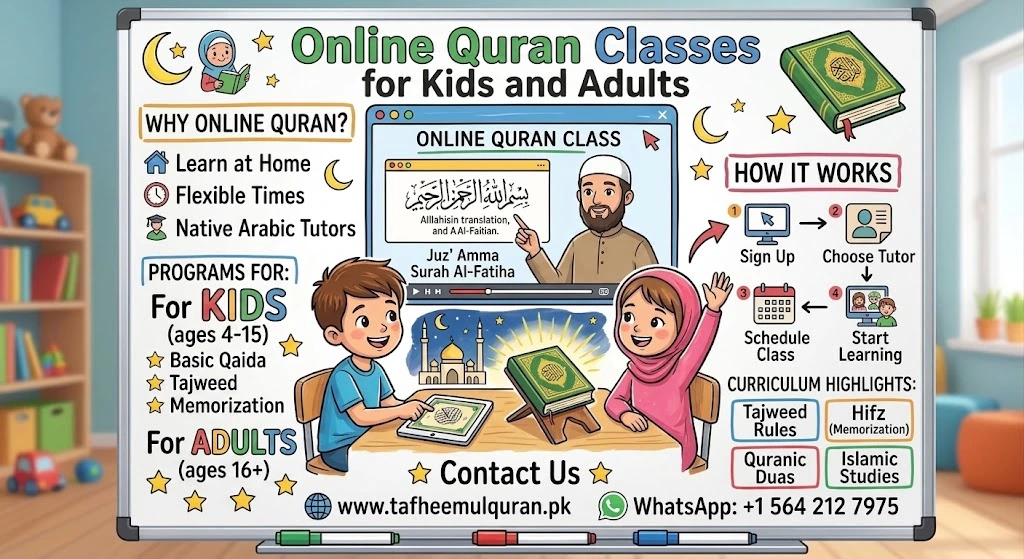
Online Quran classes for kids and adults put a live, one-on-one tutor on a video call with your child or with you, at a time that fits an American school and work schedule, teaching everything from the Arabic alphabet through Tajweed and full memorization. The right setup matters more than the word “online” does — a rushed group class and a dedicated 1:1 session are not the same product, even when both call themselves the same thing.
That distinction is where almost every article on this topic falls apart.
Why Most Comparison Pages Leave Parents More Confused
Search “online Quran classes for kids and adults” and you’ll land on pages that read like each other. Free trial, certified tutors, flexible timing, male and female teachers — every academy says all four things, in almost the same order, and none of them explain what separates a page that’s telling the truth from one that’s copying a template.
Two things get glossed over constantly.
First, the difference between a tutor marketplace and a managed academy. Sites like Qutor let you browse individual teacher profiles and pay them directly per session — you’re hiring a freelancer, and quality control is entirely on you. A managed academy assigns a vetted tutor, tracks the student’s progress against a curriculum, and has someone above the teacher checking lesson quality. Neither model is wrong. But a comparison article that doesn’t tell you which one it’s describing is wasting your time.
Second, nobody explains how to actually verify a “certified” tutor. Everyone claims certified teachers. Almost nobody says what that credential is, who issued it, or how a parent could check it before paying for a month of classes. We’ll get to that.
Kids: When to Start, and What the First Six Months Look Like
There’s no single correct starting age, but most academies begin structured lessons once a child can sit through a short session and repeat sounds back — often somewhere around age four or five, sometimes later depending on the child’s temperament. Pushing a distracted three-year-old into 30-minute sessions usually backfires; a tutor who’s actually good at teaching children will tell you to wait rather than take your money.
The first stage is almost always Noorani Qaida — the foundational primer that teaches Arabic letter recognition, joined letters, and basic pronunciation rules before a child ever opens a full mus’haf. Skip this step, or rush it, and Tajweed correction later becomes a fight against habits that are already set. A child who spends real time on Qaida reads more cleanly at year two than one who was pushed straight into Surah memorization from week one.
From there, the path usually runs: Qaida → Quran reading with fluency building → Tajweed rules applied to real recitation → short surah memorization → and, for families who want it, full Hifz.
[YOUR EXAMPLE: a specific milestone a child of yours or a student reached — e.g., finishing Qaida in X weeks, or a moment a shy child started reciting confidently]
A good online Quran kids learning program adjusts pace to the child, not the other way around. If every lesson plan looks identical regardless of the student’s age or attention span, that’s a program built around convenience for the teacher, not progress for the kid.
Adults: The Part Nobody Talks About Honestly
Adult students split into two very different groups, and most sites write for only one of them.
Group one already reads Quran, sometimes fluently, and wants Tajweed correction — the small mispronunciations picked up from childhood that nobody ever fixed. Group two is starting from zero: reverts, adults raised without access to structured Quran education, or people who simply never got past a few surahs memorized by ear. That second group carries something the first doesn’t — embarrassment. A 45-year-old sounding out letters next to a five-year-old’s workbook feels humiliating, even if nobody says so out loud.
A serious tutor treats these two groups completely differently in the first session. Someone already reading gets assessed and corrected immediately. A true beginner gets exactly the same Qaida foundation a child would get, just paced faster and explained with adult logic instead of games and stickers — no shortcuts, because the letters don’t care how old the student is.
Learning Quran online for adults works best around a real schedule constraint: work hours, a commute, kids who need putting to bed first. That’s the actual selling point of the format — not “learn anywhere,” which is vague, but “learn at 9:30pm after the kids are asleep without driving anywhere,” which is specific and true.
One thing worth saying plainly: adult progress is slower to start and faster to compound. The first month often feels discouraging. By month four, most adults who stuck with two or three sessions a week are reading independently. Quitting in week three is the single most common way adults fail at this, not lack of ability.
The Full Curriculum Path, Laid Out Honestly
Here’s the progression most reputable programs follow, in order:
- Noorani Qaida — Arabic letters, joined forms, basic makharij (pronunciation points).
- Quran reading — fluency across full pages, without heavy rule correction yet.
- Quran recitation with proper rhythm and pacing.
- Tajweed — the rule set that governs correct pronunciation, elongation, and letter characteristics.
- Quran memorization / Hifz — surah by surah, then juz by juz, for students pursuing full memorization.
- Quran translation and Tafseer, for students who want meaning alongside recitation.
Not every student needs to reach step 6. A parent who only wants a child reading correctly with sound Tajweed can stop at step 4 and revisit memorization later. Treating this as a mandatory ladder everyone must climb top to bottom is how families burn out. Trustpilot Reviews
Male and Female Tutors: This Isn’t a Minor Detail
For a meaningful share of Muslim families, teacher gender is a genuine requirement, not a preference to be accommodated if convenient. Mothers wanting a female instructor for their daughters, and sisters wanting an online female Quran tutor for themselves, is one of the most searched variations of this topic for a reason.
Ask directly, before enrolling, whether the academy can guarantee a specific gender for the full duration of the course — not just for the trial. Some platforms show you a female tutor for the free session and then quietly assign whoever’s available once you’ve paid. That’s worth confirming in writing, not assuming.
One-to-One vs. Group: Why the Format Matters More Than the Price Tag
Some platforms quietly run small group sessions and market them under the same “Quran classes” banner as private lessons, which matters because the two produce very different results.
A one to one online Quran class means the tutor hears every word your child or you recite, catches a mispronounced letter the moment it happens, and adjusts pace to one person’s ability. In a group of three or four students, that same tutor is dividing attention, and a shy student can coast through an entire session saying almost nothing out loud. For Tajweed correction specifically, group format doesn’t really work — you need someone listening closely to a single voice, not managing a small classroom over video.
If a package looks unusually cheap compared to everything else in this article, check whether it’s actually private before assuming it’s a bargain.
Does It Matter If You’re in the USA, UK, Canada, or Australia?
Not for the teaching itself — a tutor delivering Quran lessons for kids or adult Tajweed correction over video doesn’t change method based on which country the student lives in. What does shift is currency, time-zone overlap, and how a given academy structures its shift coverage.
Academies serving the US market typically price in USD and staff evening slots to overlap with American time zones after work and school. The same programs serving online Quran classes UK families price in GBP and shift their coverage toward UK evening hours instead, which sit closer to teacher time zones and are usually easier to staff. Canada and Australia both work off the USD or a local conversion depending on the platform, with Australia facing the largest time-zone gap of the four and needing genuinely deliberate scheduling rather than an afterthought.
Ask any platform serving multiple countries how they actually staff your specific time zone, rather than assuming “we teach worldwide” means your evening slot is properly covered.
English-Speaking Tutors: A Bigger Deal Than It Sounds
For families where Arabic isn’t a home language and Urdu or another South Asian language doesn’t help either, an English speaking Quran teacher isn’t a nice-to-have — it’s the difference between a child understanding why a Tajweed rule exists and just mimicking sounds without comprehension. A tutor who can explain *why* the letter ن sounds different before certain letters, in plain English, produces a student who self-corrects later. One who can only demonstrate and repeat produces a student who forgets the rule the moment the demonstration stops.
This matters just as much for adult beginners raised in the US without much exposure to Arabic or Urdu at home — ask specifically about the tutor’s spoken English fluency before the trial, not just their Quran credentials. Trustpilot Reviews
Beyond Recitation: Where Islamic Studies Fits In
Reading and memorization are the core of it, but a rounded online Islamic classes for kids program usually layers in the basics a child needs day to day — the Kalimas, correct Namaz procedure, and everyday Duas for eating, sleeping, and leaving the house. These get treated as an afterthought by a lot of pure “recitation” platforms, which is a mistake — a child who can recite fluently but doesn’t know how to pray correctly has only gotten half of what the classes were supposed to deliver.
For adults, this layer is optional but worth asking about upfront if it matters to you, since not every tutor is equipped to teach it alongside recitation.
Time Zones: The Practical Problem Nobody Solves Well
“Flexible scheduling” appears on every single competitor page. What it actually means in practice, for a family in the US, gets skipped entirely.
Here’s the real issue: most tutors are based in South Asia or the Middle East, roughly 9 to 12 hours ahead of US time zones. A 7pm Eastern slot for a family in New York is somewhere around 4am to 5am the next day for a tutor in Pakistan. That works fine when an academy runs shift-based teacher rotations built around US evenings specifically — it does not work when a platform just hands you whichever teacher happened to sign up.
Before committing to a package, ask two direct questions: does the academy run classes across all US time zones as a design choice, and what happens if your assigned tutor’s night shift schedule conflicts with a US holiday, DST change, or a family emergency on their end. A vague “we’re flexible” answer is not an answer.
What a Free Trial Should Actually Tell You
Every academy offers a free trial. Almost no article tells you what to look for during it, so families judge it purely on whether the teacher seemed “nice” — which tells you almost nothing about teaching quality.
During the trial, check these specifically:
- Does the tutor test the student’s actual level before teaching anything, or launch straight into a generic first lesson regardless of ability?
- Can the tutor explain a Tajweed rule in more than one way if the first explanation doesn’t land — or do they just repeat themselves louder?
- Is there any written note or plan sent after the session, or does the trial just… end, with no follow-up?
- Does the platform work reliably on a normal home connection, or does the “advanced learning platform” require troubleshooting before the lesson even starts?
A trial that passes all four is worth paying for. A trial that only passes the first one — friendliness — is worth a second trial with someone else before you commit a monthly fee.
What This Actually Costs
Fee pages across this industry are one of the worst-kept secrets — plenty of academies bury real numbers behind “contact us for pricing,” which wastes a parent’s time when a simple table would do. Online Quran classes fees at Tafheem ul Quran Academy are published outright, in US dollars, broken down by weekly frequency:
| Package | Classes per week | Classes per month | Duration | Monthly fee |
| Package 1 | 2 | 8 | 30 minutes | $37 |
| Package 2 | 3 | 12 | 30 minutes | $50 |
| Package 3 | 4 | 16 | 30 minutes | $66 |
| Package 4 | 5 | 20 | 30 minutes | $80 |
| Hifz Package | — | 20 | 30 minutes | $160 |
Two classes a week suits a child easing in, or an adult testing the waters around a busy schedule. Four or five suits a student on a memorization track who needs consistency to retain what they’ve reviewed. The Hifz package runs higher because dedicated memorization review takes more tutor preparation per session than standard reading correction — that’s a real cost difference, not padding.
For a longer breakdown of what drives pricing differences between academies generally, see How Much Do Online Quran Classes Cost in the USA.
“Certified Teacher” Means Nothing Until You Check It
This is the gap that costs families the most, and it’s the one almost no comparison article addresses directly.
“Certified” and “qualified” get used so loosely across this industry that the words have stopped meaning anything on their own. What actually matters is whether a tutor holds a verifiable Ijazah — a documented chain of authorization in Quran recitation, traceable back through a line of qualified teachers — as opposed to simply having taught for a number of years. Years of experience and a real Ijazah are not the same credential, and a page that uses them interchangeably is hoping you won’t ask the difference.
Before enrolling, ask which specific credential the assigned tutor holds, and ask to see it — not just a claim that teachers are “Al-Azhar trained” in general marketing copy, but the actual named qualification of the person who will be teaching your child every week. A legitimate academy has no reason to dodge that question. If you get a vague non-answer, that’s information too.
Academic oversight matters here as well. A program where lesson quality gets reviewed by someone other than the teacher themselves — a supervision layer checking recordings or progress notes periodically — catches problems a lot faster than a platform where the only feedback loop is a parent noticing something’s wrong months later.
For Sisters and Women: What “Comfortable” Actually Requires
Online Quran classes for women and Quran classes for sisters searches spike for a specific reason — plenty of adult women either never had access to structured Quran education growing up, or stopped after marriage and children took over the schedule, and want back in without the discomfort of a mixed-gender classroom setting they might have experienced elsewhere.
A program built properly around this doesn’t just assign a female tutor and call it done. It means the platform itself — the video call, the messaging, the scheduling — never puts a woman in a position where she’s waiting on a call with an unfamiliar male administrator to sort out a billing issue when a female point of contact could have handled it just as easily. Small operational details like that are usually a better signal of how seriously an academy takes this than the marketing copy is.
Common Mistakes Families Make Choosing an Academy
Picking the first result that shows up isn’t the actual mistake — most of these platforms are functionally similar on the surface. The mistakes happen after signup.
Skipping the trial evaluation checklist above and judging purely on personality. Not confirming tutor gender in writing when it’s a hard requirement, not a preference. Choosing the cheapest package and then wondering why a child isn’t progressing on two 30-minute sessions a week when the goal was full Hifz — that pace mismatch is predictable and avoidable if the package is matched to the actual goal upfront.
And the big one for adults specifically: quitting during the awkward early weeks, right before the point where reading starts clicking.
Evenings, Weekends, and Life Around Work
Busy adults and school-age kids both need the same practical thing: a slot that doesn’t compete with homework, dinner, or a work shift. Evening Quran classes after 6pm and weekend Quran classes on Saturday or Sunday mornings are the two most requested slots for US families for exactly that reason, and any platform worth using should be able to place you into one without a long waiting list.
If a scheduling team tells you evenings and weekends are “usually full,” ask how far out you’d actually need to book — a vague answer there is often a sign the platform is short on tutors during peak US hours, not that demand is genuinely maxed out.
Quick Answers
Do online Quran classes actually work as well as in-person ones? For recitation, Tajweed, and memorization, yes — a tutor can hear pronunciation over video just as clearly as in a room, and screen-sharing works fine for Qaida and text. What’s harder to replicate online is the social structure of a physical madrasa; that’s a trade-off, not a dealbreaker.
How long does it take an adult beginner to read independently? With two to three sessions a week and daily practice between them, most adult beginners move from the alphabet to independent (if imperfect) reading somewhere around three to four months. Faster with more weekly sessions, slower with fewer.
Can I request a different tutor if the trial doesn’t go well? At any legitimate academy, yes, and you should ask without hesitation — a mismatch in teaching style is common and isn’t a reflection on the student.
Is Noorani Qaida necessary for a child who already knows some Arabic letters? Usually still worth doing in full. Partial letter knowledge without the joined-letter rules and pronunciation points tends to create gaps that surface later during Tajweed correction.
Can siblings share one package to save money? Each child needs their own full session with the tutor’s undivided attention, so splitting a single package’s time slot between two children isn’t really workable. If you’re enrolling more than one child, ask the academy directly whether a multi-child discount exists — policies vary and it’s worth confirming before assuming either way.
Where to Start
If you’re weighing this decision for your own family, don’t start by comparing marketing pages against each other — start with a Register For Online Classes trial session, run it through the four-point checklist above, and ask the credential question directly before you pay for a single package. That’s the actual comparison that matters, not how many times a homepage says “flexible” and “certified.”
Online Quran classes built around one-on-one attention, a real curriculum, and tutors whose credentials you can name and verify will outperform a cheaper option built around neither — every time, for both a five-year-old starting Qaida and a 40-year-old adult finally getting around to it.
Frequently Asked Questions: Online Quran Classes for Kids and Adults in the USA
1. Which online Quran class is best for kids?
provide live, one-to-one virtual lessons with certified male and female tutors from the comfort of home. — that combination matters more than any single feature on its own. Beyond that baseline, look for a tutor who tests the child’s level first, teaches Noorani Qaida properly before rushing into memorization, and adjusts pace to the child rather than following a fixed script. Judge this during the free trial, not from marketing copy alone.
2. Which online Quran class is the best?
There isn’t one universal answer, since “best” depends on the goal — a beginner adult needs a different setup than a child pursuing Hifz. The stronger signal across any program is verifiable tutor credentials, published pricing, one-on-one attention, and a trial that actually assesses ability before teaching.
3. Are there any free online Quran classes for kids?
Some platforms offer ongoing free lessons, but most reputable academies offer a free trial class rather than a permanently free program, since consistent one-on-one teaching requires paid tutor time to sustain quality.
4. How much does an online Quran class cost?
Pricing is usually structured by weekly frequency. Typical monthly packages range from around $37 for two classes a week up to $80 for five classes a week, with dedicated Hifz (memorization) packages priced higher due to the extra tutor preparation involved.
5. What age should a child start online Quran classes?
Most academies start structured lessons around age four or five, once a child can sit through a short session and repeat sounds back. Younger than that, attention span usually becomes the limiting factor, not ability.
6. Can adults really learn to read Quran from scratch online?
Yes. Adult beginners follow the same Noorani Qaida foundation as children, just explained with adult logic and paced faster, and most reach independent reading within three to four months of consistent classes.
7. Are online Quran classes as effective as in-person classes?
For recitation, Tajweed correction, and memorization, yes — a tutor hears pronunciation over video just as clearly as in a room. What’s harder to replicate is the social classroom setting of a physical madrasa.
8. Do online Quran academies offer a free trial class?
Nearly every legitimate academy offers at least one free trial session before you commit to a paid package, so you can evaluate the tutor’s teaching style first.
9. What should I actually check during a free trial class?
Watch for whether the tutor assesses the student’s level before teaching, explains rules more than one way if needed, sends a follow-up note, and whether the video platform runs smoothly on a normal home connection.
10. Can I request a female Quran teacher for my daughter or myself?
Yes, most academies offer dedicated female Quran tutors for girls and women. Confirm in writing that the same tutor stays assigned for the full course, not just the trial.
11. What’s the difference between a Quran tutor marketplace and a Quran academy?
A marketplace lets you browse and hire individual freelance teachers directly, with quality control left to you. A managed academy assigns a vetted tutor and tracks progress against a curriculum with oversight above the teacher.
12. What does “certified Quran teacher” actually mean?
It should mean the tutor holds a verifiable Ijazah — a documented chain of authorization in Quran recitation — rather than simply years of teaching experience. Ask to see the specific credential before enrolling.
13. What is Noorani Qaida and why does my child need it first?
Noorani Qaida is the foundational primer teaching Arabic letter recognition, joined letters, and pronunciation points before a student reads full Quran pages. Skipping it usually creates habits that are harder to correct later.
14. What is Tajweed and do I need it if I can already read Quran?
Tajweed is the rule set governing correct pronunciation, elongation, and letter characteristics. Adults who already read often still need Tajweed correction for mispronunciations picked up early on that were never fixed.
15. What’s the difference between Quran memorization (Hifz) and regular Quran reading classes?
Regular Quran reading classes focus on fluency and correct pronunciation; Hifz classes are structured specifically around memorizing and retaining surahs through repeated review, which requires more tutor time per session.
16. How many classes per week are needed for Hifz (memorization)?
Students on a serious memorization track usually take four to five classes a week to keep review consistent, since gaps between sessions make retention harder.
17. Can working adults fit Quran classes around a 9-to-5 schedule?
Yes — evening and weekend slots are the most requested times for exactly this reason, and most academies staff specifically for after-work and after-school US hours.
18. Do online Quran classes work across different US time zones?
They should. Ask directly whether an academy runs shift-based tutor coverage designed around all US time zones, rather than assuming general “flexible” scheduling covers your specific evening slot.
19. Are online Quran teachers fluent in English?
Quality varies by academy. For families where Arabic or Urdu isn’t spoken at home, ask specifically about a tutor’s spoken English fluency, since a tutor who can explain rules in plain English produces faster comprehension than one who only demonstrates.
20. Is one-on-one Quran tutoring better than group classes?
For Tajweed correction and steady progress, yes. In a group of three or four students, a tutor’s attention is divided, and a shy student can go an entire session saying very little out loud.
21. Can siblings share one Quran class package?
Not really — each child needs their own full session with the tutor’s undivided attention. Ask the academy directly whether a separate multi-child discount is available instead.
22. What if my child doesn’t get along with the assigned tutor?
Any legitimate academy will let you request a different tutor. A mismatch in teaching style is common and isn’t a reflection on the student’s ability.
23. Do online Quran classes teach more than just recitation?
A well-rounded program often includes daily Duas, Kalimas, and correct Namaz procedure alongside recitation and Tajweed, especially for kids’ programs.
24. Is it normal for adults to feel embarrassed starting Quran lessons late?
It’s common, but a serious tutor treats adult beginners with the same structured foundation as children, just explained differently — there’s no shortcut around the letters regardless of age.
25. Can I try a different Quran course type if the first one isn’t the right fit?
Yes — most academies let you switch between reading, Tajweed-focused, or Hifz-focused tracks once your goals become clearer after a few sessions.
26. Are 30-minute Quran classes long enough for real progress?
For most kids and beginner adults, yes, especially at first — 30 minutes keeps focus high without fatigue. Advanced Hifz students sometimes benefit from more frequent sessions rather than longer single classes.
27. Is online Quran learning safe for young children?
Reputable academies pair kids with vetted tutors, keep sessions parent-visible, and offer female teachers for girls specifically for comfort and safety reasons — ask about supervision policies before enrolling.
28. How do I know if an online Quran academy is legitimate?
Check for a published fee structure, named tutor credentials you can verify, a real free trial, and a way to reach a human for scheduling or billing issues — vague pricing and generic “certified” claims are red flags.
29. Which online Quran course should a complete beginner adult start with?
The same Noorani Qaida foundation a child would start with, just paced faster and explained with adult logic — skipping straight to memorization or advanced reading usually backfires.
30. What’s the best way to start if I’m not sure which course my family needs? Book a free trial, run it through a short evaluation (does the tutor test level first, explain clearly, follow up
Where to Start
If you’re weighing this decision for your own family, don’t start by comparing marketing pages against each other — start with a Register For Online Classes trial session, run it through the four-point checklist above, and ask the credential question directly before you pay for a single package. That’s the actual comparison that matters, not how many times a homepage says “flexible” and “certified.”
Online Quran classes in United States built around one-on-one attention, a real curriculum, and tutors whose credentials you can name and verify will outperform a cheaper option built around neither — every time, for both a five-year-old starting Qaida and a 40-year-old adult finally getting around to it.